
Every year, millions of people making student loan payments ask the same question: are these payments actually tax deductible? The honest answer is a bit more nuanced than a simple yes or no — and understanding the distinction can mean the difference between missing out on real savings and claiming a deduction you’re fully entitled to.
This guide clears up exactly what part of your student loan payment is deductible, walks through how to claim it on your tax return step by step, and flags the mistakes that cause eligible borrowers to leave money on the table.
This article is for general informational purposes only and isn’t personalized tax advice. Consult a licensed tax professional or IRS Publication 970 for guidance specific to your situation.
Are Student Loan Payments Tax Deductible? The Short Answer
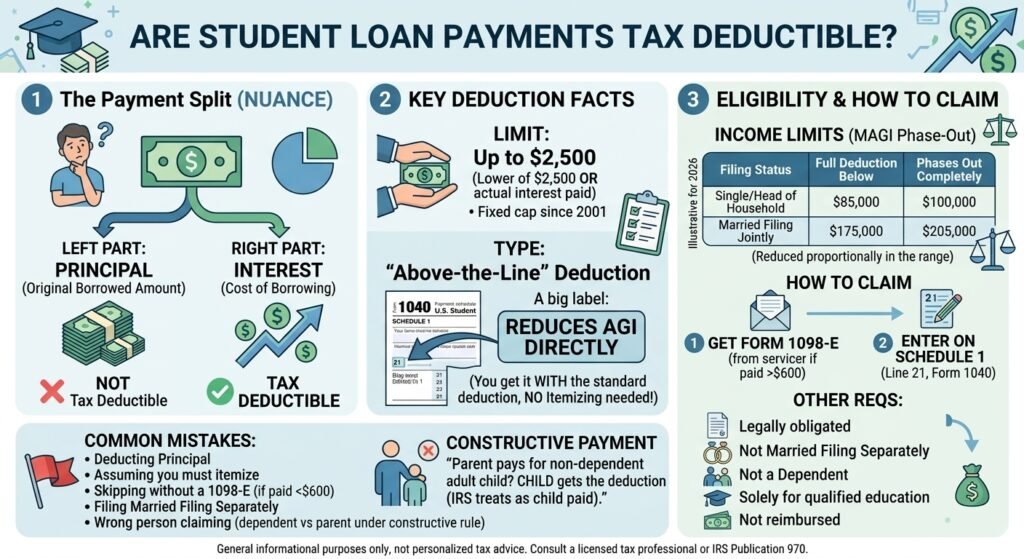
Not entirely — and this is the key distinction. Every student loan payment you make is typically split into two parts:
- Principal — the original amount you borrowed. This is never tax deductible, no matter how much you pay.
- Interest — the cost of borrowing that money. This portion can be tax deductible, up to certain limits.
So when someone asks “can I deduct my student loan payment,” the accurate answer is: you can’t deduct the payment itself, but you can deduct the interest portion of what you paid, through the student loan interest deduction.
How Much Student Loan Interest Can You Deduct?
You can deduct whichever is lower:
- $2,500, or
- The actual amount of interest you paid during the tax year
This $2,500 cap has been fixed since 2001 and isn’t adjusted for inflation, so even if you paid $6,000 in interest, your deduction still tops out at $2,500.
It’s an Above-the-Line Deduction
This detail matters more than most people realize: the student loan interest deduction is claimed as an adjustment to income on Schedule 1, Line 21 of Form 1040 — not as an itemized deduction on Schedule A. That means:
- You get it even if you take the standard deduction
- You don’t need to itemize to qualify
- It directly reduces your Adjusted Gross Income (AGI), which can have knock-on benefits for other credits and deductions
Income Limits: Who Can Deduct Student Loan Interest?
The deduction phases out as your Modified Adjusted Gross Income (MAGI) increases. Here are the current thresholds:
| Filing Status | 2025 Full Deduction Below | 2025 Phases Out Completely | 2026 Full Deduction Below | 2026 Phases Out Completely |
|---|---|---|---|---|
| Single / Head of Household | $85,000 | $100,000 | $85,000 | $100,000 |
| Married Filing Jointly | $170,000 | $200,000 | $175,000 | $205,000 |
| Married Filing Separately | Not eligible | Not eligible | Not eligible | Not eligible |
If your MAGI falls between the lower and upper threshold for your filing status, your deduction is reduced proportionally rather than eliminated all at once.
Other Eligibility Requirements
To deduct student loan interest, you must also:
- Be legally obligated to repay the loan (it must be in your name)
- Not be filing as Married Filing Separately
- Not be claimed as a dependent on someone else’s return
- Have used the loan solely for qualified education expenses
- Not have already been reimbursed by an employer for that interest
How to Deduct Student Loan Interest on Your Tax Return: Step-by-Step?
Step 1: Locate Form 1098-E
Your loan servicer sends this form if you paid $600 or more in interest during the year. If you paid less, you generally won’t receive it automatically — but you can still claim the deduction using your account statements or by requesting a summary from your servicer.
Step 2: Confirm Your Eligibility
Check your filing status and MAGI against the table above to see whether you qualify for the full deduction, a reduced amount, or none at all.
Step 3: Calculate Your Deductible Amount
Take the interest shown on your 1098-E (or your own records) and compare it to the $2,500 cap. If your MAGI falls within the phase-out range, the deduction is reduced accordingly.
Step 4: Enter It on Schedule 1
Report the deduction on Schedule 1, Line 21 of Form 1040. This flows through to reduce your total income before your AGI is calculated — no Schedule A or itemizing needed.
Step 5: File as Normal
Since this is an above-the-line deduction, you can still take the standard deduction on top of it. There’s no trade-off between the two.
What If Someone Else Pays Your Student Loan?
This comes up often with parents helping adult children with payments. Under the IRS’s constructive payment rule:
- If a parent makes payments on a loan that is legally in their non-dependent adult child’s name, the child — not the parent — gets to claim the deduction, since the IRS treats it as though the child received the money and paid it themselves.
- If the child is still claimed as a dependent, neither party can claim the deduction.
Common Mistakes That Cost Borrowers Money
- Trying to deduct principal payments only the interest portion qualifies, ever
- Assuming you need to itemize this deduction works alongside the standard deduction
- Skipping the deduction without a 1098-E you can still claim interest paid under $600
- Filing Married Filing Separately without realizing it disqualifies the deduction entirely
- Not checking whether a parent or dependent should be the one claiming it under the constructive payment rule
Frequently Asked Questions
Q1. Are my full student loan payments tax deductible?
Ans. No. Only the interest portion of your payments is deductible, up to $2,500 per year — the principal you repay is never deductible.
Q2.Do I have to itemize to deduct student loan interest?
Ans.No. It’s an above-the-line deduction claimed on Schedule 1, so you can take it even with the standard deduction.
Q3.What form do I need to deduct student loan interest?
Ans.Form 1098-E from your loan servicer shows how much interest you paid, if it was $600 or more. You report the deductible amount on Schedule 1, Line 21 of Form 1040.
Q4.Can I deduct student loan interest if my income is high?
Ans.Only up to the phase-out limits — $100,000 MAGI for single filers and $205,000 for joint filers in 2026. Above those amounts, no deduction is allowed.
Q5.Can I deduct student loan interest if I’m married filing separately?
Ans. No. This filing status is disqualified from the deduction regardless of income level.
Final Thoughts
Your student loan payments themselves aren’t tax deductible — but the interest you pay on them is, and it’s one of the most accessible tax breaks available since it doesn’t require itemizing. Gathering your Form 1098-E, checking your income against the current MAGI thresholds, and correctly reporting the deduction on Schedule 1 can put real money back in your pocket each tax season. When in doubt about your specific situation, a licensed tax professional can confirm exactly what you’re eligible to claim.
Disclaimer: This article is for informational purposes only and does not constitute financial or tax advice. Consult a licensed tax professional or refer to IRS Publication 970 for guidance specific to your situation.