If you’re paying off student loans, tax season probably raises a few questions: Do you have to report your student loans on your taxes? Can the interest you paid actually lower your tax bill? And is there such a thing as a student loan repayment tax credit?
The short answer is that your loan balance itself is not something you report as income — but the interest you paid on it may qualify for a valuable deduction, and in a handful of states, ongoing repayment can unlock a separate tax credit. This guide breaks down exactly what you do and don’t have to claim, how the federal student loan interest deduction works for the 2025 and 2026 tax years, and where state-level repayment credits exist.
This article is for general information only and isn’t personalized tax advice. Tax rules change and individual situations vary, so verify current figures on IRS.gov or with a licensed tax professional before filing.
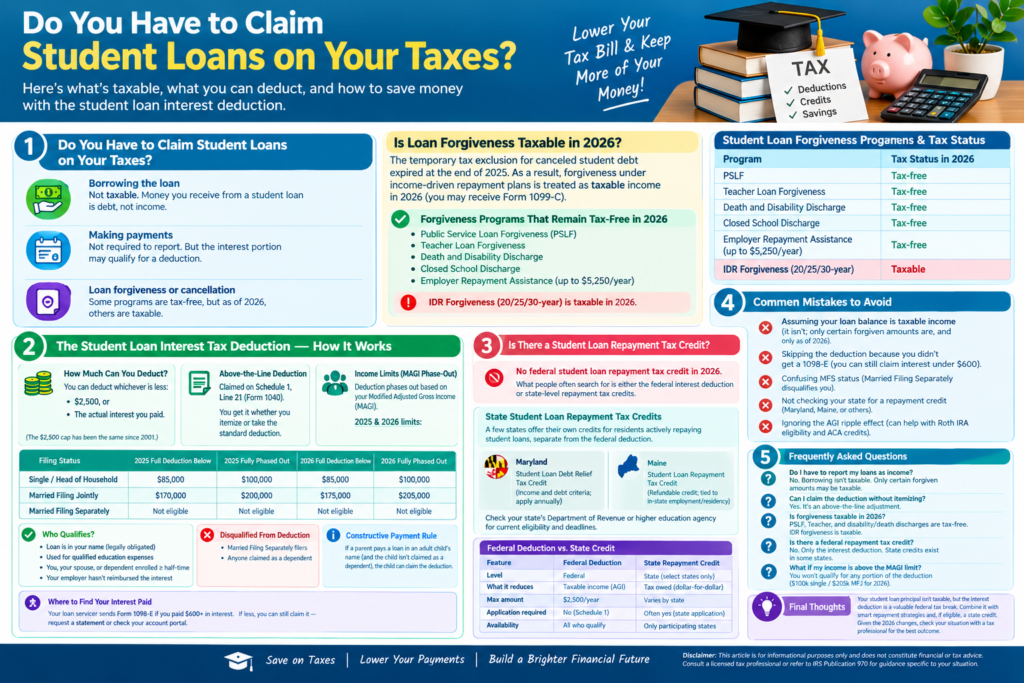
Do You Have to Claim Student Loans on Your Taxes?
This is the most common point of confusion, so let’s separate it clearly:
- Borrowing the loan: Not taxable. Money you receive from a student loan is debt, not income, so you never report it as earnings.
- Making payments: Not something you’re required to report either — but the interest portion of what you paid may qualify you for a deduction (more below).
- Loan forgiveness or cancellation: This is where things get more complex. Certain forgiveness programs are tax-free, but as of 2026, some are not.
Is Loan Forgiveness Taxable in 2026?
A temporary tax exclusion for canceled student loan debt, created under the American Rescue Plan Act, expired at the end of 2025. As a result, forgiveness under income-driven repayment plans (after 20, 25, or 30 years of payments) is treated as taxable income starting in 2026 — the IRS considers it as if you received cash to pay off the debt, and you may receive Form 1099-C for the canceled amount.
However, several major forgiveness programs remain tax-free even in 2026:
| Program | Tax Status in 2026 |
|---|---|
| Public Service Loan Forgiveness (PSLF) | Tax-free |
| Teacher Loan Forgiveness | Tax-free |
| Death and Disability Discharge | Tax-free |
| Closed School Discharge | Tax-free |
| Employer Student Loan Repayment Assistance (up to $5,250/year) | Tax-free |
| IDR Forgiveness (20/25/30-year cancellation) | Taxable as of 2026 |
If you’re expecting forgiveness through an income-driven plan in the near future, it’s worth talking to a tax professional about setting aside funds or exploring relief options like the insolvency exclusion.
Student Loan Interest Tax Deduction — How It Works
Unlike your loan balance, the interest you pay is where real tax savings live.
How Much Can You Deduct?
You can deduct whichever is less:
- $2,500, or
- The actual interest you paid during the year
This cap has stayed at $2,500 since 2001 and is not adjusted for inflation, so the real value of the deduction has shrunk over time — but it’s still worth claiming every year you qualify.
It’s an “Above-the-Line” Deduction
This is what makes the deduction so widely usable: it’s claimed on Schedule 1, Line 21 of Form 1040 as an adjustment to income, not an itemized deduction. That means you get it whether you itemize or take the standard deduction — no Schedule A required.
2025 and 2026 Income Limits (MAGI Phase-Out)
The deduction phases out as your Modified Adjusted Gross Income (MAGI) rises, based on IRS inflation adjustments:
| Filing Status | 2025 Full Deduction Below | 2025 Fully Phased Out | 2026 Full Deduction Below | 2026 Fully Phased Out |
|---|---|---|---|---|
| Single / Head of Household | $85,000 | $100,000 | $85,000 | $100,000 |
| Married Filing Jointly | $170,000 | $200,000 | $175,000 | $205,000 |
| Married Filing Separately | Not eligible | Not eligible | Not eligible | Not eligible |
Two groups are disqualified from this deduction entirely, regardless of income:
- Married Filing Separately filers barred under the tax code with no exceptions
- Anyone claimed as a dependent on someone else’s return
Who Else Qualifies?
- You’re legally obligated to repay the loan (it must be in your name)
- The loan was used solely for qualified higher education expenses
- The student was you, your spouse, or your dependent, enrolled at least half-time in a degree or credential program
- Your employer hasn’t already reimbursed you for that interest
A Useful Detail: The Constructive Payment Rule
If a parent makes payments on a loan that’s legally in their adult child’s name — and that child isn’t claimed as a dependent — the IRS allows the child (not the parent) to claim the deduction, since they’re treated as having received the money and paid it themselves.
Where to Find Your Interest Paid
Your loan servicer sends Form 1098-E if you paid $600 or more in interest during the year. If you paid less than $600, you generally won’t get the form automatically, but you can still claim the deduction — just request a statement from your servicer or check your account portal.
Is There a Student Loan Repayment Tax Credit?
Here’s an important distinction: there is no federal student loan repayment tax credit in 2026. What people are often searching for is either:
- The federal student loan interest deduction (covered above), or
- State-level repayment tax credits, which do exist in a limited number of states
State Student Loan Repayment Tax Credits
A few states offer their own credits for residents actively repaying student loans, separate from the federal deduction:
- Maryland’s Student Loan Debt Relief Tax Credit available to Maryland residents who meet income and debt criteria, applied for annually through the state’s higher education commission
- Maine’s Student Loan Repayment Tax Credit a refundable credit for Maine residents making qualifying payments on eligible loans, notably tied to certain in-state employment and residency conditions
Because these programs vary significantly by state, have their own applications, and change from year to year, check your state’s Department of Revenue or higher education agency website for current eligibility and deadlines rather than assuming a credit applies to you.
Federal Deduction vs. State Credit: What’s the Difference?
| Student Loan Interest Deduction | State Repayment Tax Credit | |
|---|---|---|
| Level | Federal | State (select states only) |
| What it reduces | Taxable income (AGI) | Tax owed, dollar-for-dollar (if refundable) |
| Max amount | $2,500/year | Varies by state |
| Application required | No — claim on Schedule 1 | Often yes — separate state application |
| Availability | All U.S. taxpayers who qualify | Only residents of participating states |
Common Mistakes to Avoid
- Assuming your loan balance is taxable income it isn’t; only certain forgiven amounts are, and only as of 2026
- Skipping the deduction because you didn’t get a 1098-E you can still claim interest under $600
- Confusing MFS status filing Married Filing Separately disqualifies you from the interest deduction no matter your income
- Not checking your state for a repayment tax credit if you live in Maryland, Maine, or another participating state
- Ignoring the AGI ripple effect lowering your AGI through this deduction can also help with Roth IRA eligibility and ACA premium tax credits
Frequently Asked Questions
Q1. Do I have to report my student loans as income on my tax return?
Ans. No. Borrowing a student loan is not taxable income. Only certain forgiven or canceled amounts may be taxable, depending on the program and the year.
Q2. Can I claim the student loan interest deduction without itemizing?
Ans. Yes. It’s an above-the-line adjustment to income, so you get it even if you take the standard deduction.
Q3. Is student loan forgiveness taxable in 2026?
Ans. It depends on the program. PSLF, Teacher Loan Forgiveness, and disability/death discharges remain tax-free. Forgiveness through income-driven repayment plans (after 20–30 years) became taxable again starting in 2026.
Q4. Is there a federal student loan repayment tax credit?
Ans. No at the federal level, the benefit is the interest deduction, not a credit. Repayment tax credits currently exist only at the state level, such as in Maryland and Maine.
Q5. What if my income is above the MAGI limit?
Ans. You won’t qualify for any portion of the deduction once your MAGI exceeds the upper threshold for your filing status ($100,000 single / $205,000 MFJ for 2026).
Final Thoughts
Understanding what you actually have to claim on your taxes — and what you can deduct — can save you real money every filing season. While your student loan principal isn’t taxable, the interest deduction is one of the few federal tax breaks available to nearly every borrower regardless of whether they itemize, and residents of certain states may have an additional repayment credit worth pursuing. Given that forgiveness taxability changed for 2026, it’s worth double-checking your specific situation with a tax professional, especially if you’re nearing loan forgiveness.
Disclaimer: This article is for informational purposes only and does not constitute financial or tax advice. Consult a licensed tax professional or refer to IRS Publication 970 for guidance specific to your situation.