Once you’ve maxed out federal student aid, private student loans often become the next step to cover the gap. But figuring out where to actually get one can be confusing — many major banks quietly exited the student loan business years ago, while online lenders and credit unions have taken their place. And once you’re repaying, a natural follow-up question comes up: are any of those payments tax deductible?
This guide covers exactly where to apply for private student loans in 2026, which banks and lenders currently offer them, how the application process works, and what you can (and can’t) deduct on your taxes once repayment begins.
This article is for general informational purposes only and isn’t personalized financial or tax advice. Rates, lender availability, and eligibility criteria change frequently — always confirm current terms directly with a lender and consult a tax professional for your specific situation
Private vs. Federal Student Loans: A Quick Refresher
Before applying anywhere, it helps to know why private loans exist at all:
- Federal loans come from the U.S. Department of Education, have fixed rates set by Congress, and include protections like income-driven repayment and forgiveness programs.
- Private loans come from banks, credit unions, and online lenders. Rates depend on your (or a cosigner’s) credit, and they don’t include federal protections.
Most financial experts recommend exhausting federal loan options first, since private loans typically lack the safety nets federal loans offer — and are best used to fill a funding gap, not as a first resort.
Do Banks Still Offer Student Loans?
This is where a lot of borrowers get tripped up — several major, well-known banks no longer offer student loans at all:
| Bank | Offers Student Loans? |
|---|---|
| Bank of America | No — ended its private student loan program in 2008 |
| Chase | No — sold its student loan portfolio to Navient in 2017 |
| PNC | Yes |
| Citizens Bank | Yes |
| Discover | No — exited the student loan market entirely, selling its portfolio to other institutions |
Because so few traditional national banks remain in this space, most borrowers today end up applying through online lenders or a small number of banks that still specialize in education lending — not their everyday checking-account bank.
Where to Apply for Private Student Loans: Your Main Options
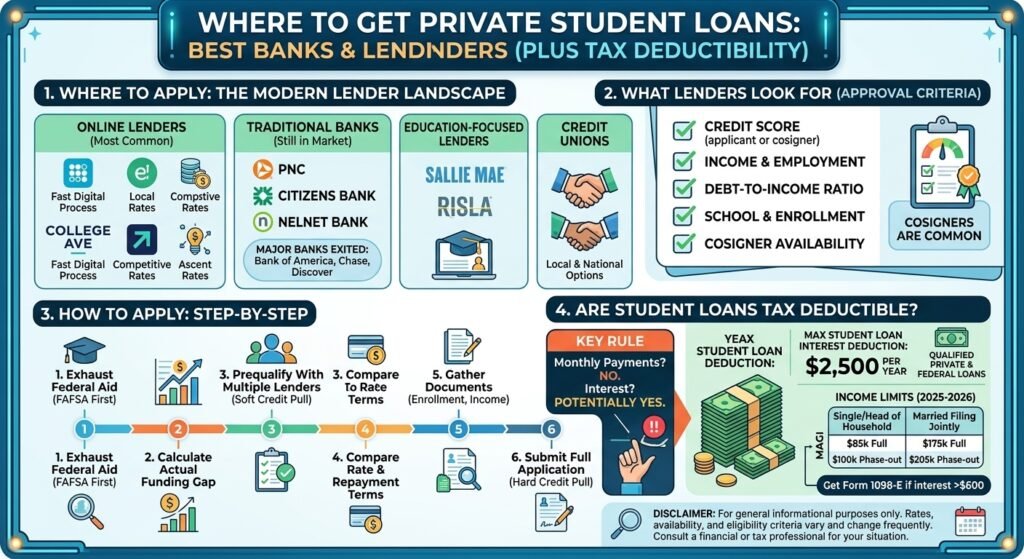
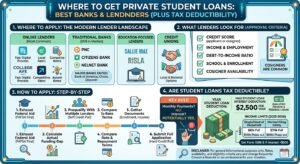
1. Online-Only Lenders
These have become the dominant source of private student loans and typically offer fast pre-qualification, competitive rates for strong credit, and fully digital applications. Well-known names in this category include:
- SoFi known for a broad suite of financial products beyond just loans
- Earnest often cited for flexible repayment terms and holistic underwriting beyond just credit score
- College Ave known for a quick credit decision process
- Ascent offers options for borrowers without a cosigner in some cases
2. Traditional Banks Still in the Market
A small number of banks continue to offer private student loans directly, including Citizens Bank, PNC, and Nelnet Bank.
3. Education-Focused Lenders
Some lenders specialize specifically in student and parent loans rather than general banking, such as Sallie Mae (one of the largest and longest-standing private student loan providers) and RISLA (Rhode Island Student Loan Authority, which lends nationally despite the name).
4. Credit Unions
Local and national credit unions often offer private student loans with member-friendly terms, though availability and rates vary significantly by institution and membership eligibility.
5. Loan Marketplaces
Comparison sites let you check rates across multiple lenders with a single soft credit pull, which can be a faster way to shop around than applying individually.
What Banks and Lenders Look For?
Approval and your rate typically depend on:
- Credit score many lenders look for a minimum in the mid-to-high 600s for the applicant or cosigner
- Income and employment (or a cosigner’s, if you’re a student with limited credit history)
- Debt-to-income ratio
- School and enrollment status some lenders only fund at accredited, degree-granting institutions
- Cosigner availability the vast majority of undergraduate private loan borrowers apply with a cosigner, since most students don’t yet have the credit history to qualify alone.
How to Apply for a Private Student Loan: Step-by-Step?
Step 1: Exhaust Federal Aid First
Complete the FAFSA and accept all available federal loans, grants, and scholarships before turning to private options.
Step 2: Calculate Your Actual Funding Gap
Only borrow privately for the difference between your school’s cost of attendance and what federal aid, savings, and scholarships already cover.
Step 3: Prequalify With Multiple Lenders
Most online lenders let you check estimated rates with a soft credit pull that doesn’t affect your credit score, so compare several before committing.
Step 4: Compare More Than Just the Interest Rate
Look at repayment terms, whether a cosigner release is offered, deferment options while in school, and any fees.
Step 5: Gather Your Documents
Typically includes proof of enrollment, income verification (for you or your cosigner), and identification.
Step 6: Submit Your Full Application
This involves a hard credit pull. Once approved, funds are usually sent directly to your school.
Are Student Loan Payments Tax Deductible?
Once you’re repaying, here’s the part that surprises many borrowers: your loan payments themselves are not tax deductible but a portion of the interest may be.
What Actually Qualifies
- Principal payments never deductible, regardless of how much you pay
- Interest payments may qualify for the student loan interest deduction, up to $2,500 per year
This applies to both federal and qualified private student loans, as long as the loan was used solely for qualified education expenses.
Key Rules for 2025–2026
- It’s an above-the-line deduction, claimed on Schedule 1, Line 21 — so you get it even if you take the standard deduction
- The deduction phases out based on your Modified Adjusted Gross Income (MAGI):
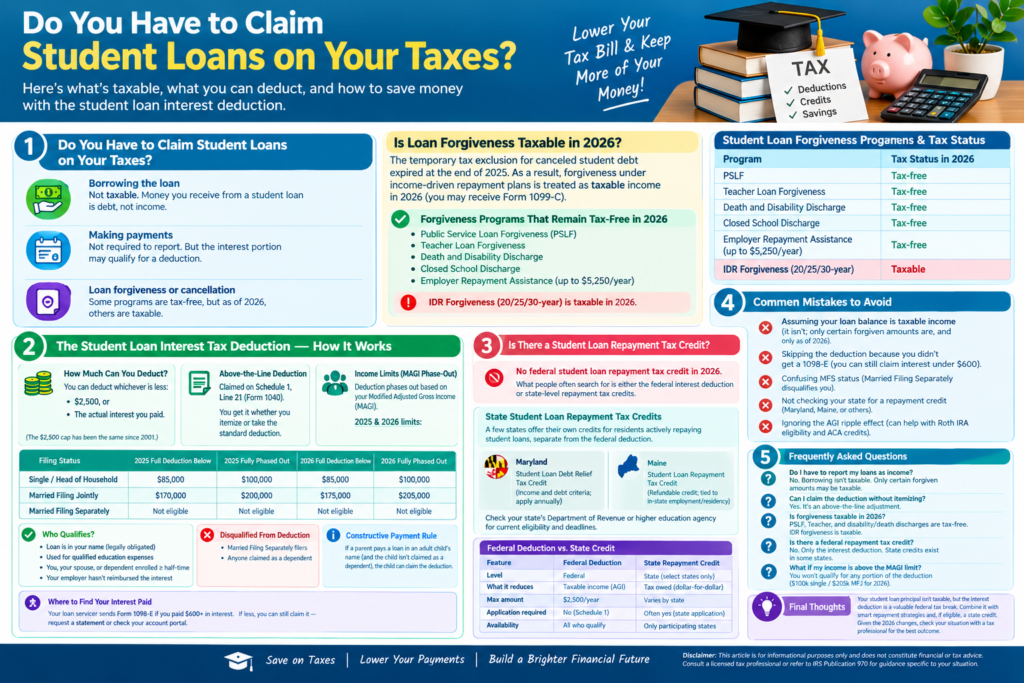
| Filing Status | 2026 Full Deduction Below | 2026 Fully Phased Out |
|---|---|---|
| Single / Head of Household | $85,000 | $100,000 |
| Married Filing Jointly | $175,000 | $205,000 |
| Married Filing Separately | Not eligible | Not eligible |
- Your loan servicer sends Form 1098-E if you paid $600 or more in interest during the year.
Common Mistakes to Avoid
- Assuming your regular bank offers student loans many major banks, including Bank of America and Chase, no longer do.
- Applying with only one lender rates vary widely between lenders for the same credit profile.
- Borrowing more privately than your actual funding gap requires.
- Trying to deduct loan principal only the interest portion is ever deductible.
- Not shopping for a cosigner release option, which matters if a parent or relative cosigns.
Frequently Asked Questions
Q1. Which banks still offer student loans?
Ans. Citizens Bank, PNC, and Nelnet Bank remain active in student lending. Bank of America, Chase, and Discover have all exited the private student loan market.
Q2.Where is the best place to get a private student loan?
Ans. There’s no single “best” lender it depends on your credit profile, whether you need a cosigner, and what repayment terms matter most to you. Comparing pre-qualified rates across several online lenders is the most reliable approach.
Q3.Can I deduct interest on a private student loan?
Ans.Yes, as long as the loan was used solely for qualified education expenses and you meet the other IRS eligibility requirements private loans aren’t excluded from the deduction.
Q4.Do private student loan payments count as a tax deduction?
Ans.Only the interest portion, up to $2,500 per year, and only if your income falls within the MAGI limits for your filing status.
Q5.Is it hard to get approved for a private student loan?
Ans. It can be, especially without a cosigner a large share of applicants are denied under current underwriting standards, which is part of why most undergraduate borrowers apply with a cosigner.
Final Thoughts
Finding the right place to get a private student loan means looking beyond your everyday bank most major banks have exited this market, leaving online lenders, education-focused lenders, and credit unions as the primary sources today. Once you’re repaying, remember that only the interest you pay is potentially tax deductible, not your monthly payment as a whole. Comparing multiple lenders before you borrow, and claiming the interest deduction correctly once you’re repaying, are two of the simplest ways to keep the true cost of your education debt down.
Disclaimer: This article is for informational purposes only and does not constitute financial or tax advice. Loan rates and lender availability change frequently — verify current terms with lenders directly and consult a tax professional for guidance specific to your situation.